


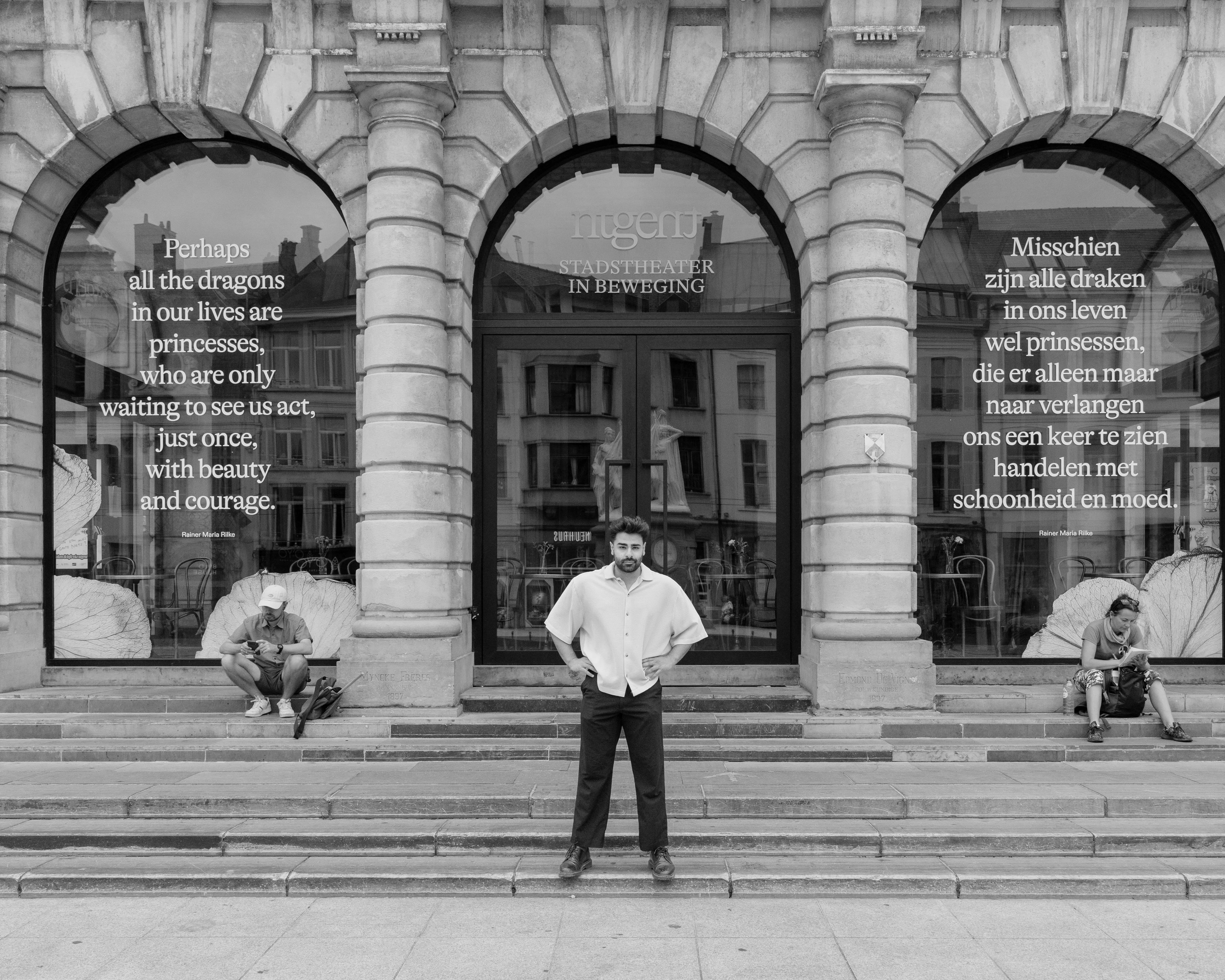

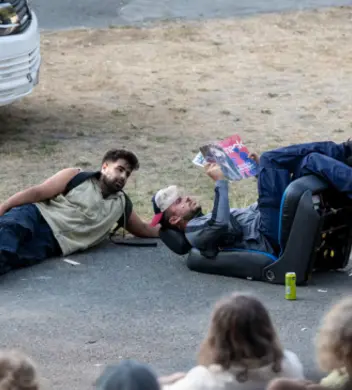


Actor and performer Armin Mola joins Arber Aliaj, Lara Staal and Matthias Velle for De blauw, a musical site-specific performance examining the relationship between police and youth. Built from interviews with police officers, young people and youth workers, the performance explores prejudice, power, safety and the stories we tell about one another. As the actors move through public space in a converted police van, De blauw brings different perspectives into dialogue, making room for listening, questioning and seeing one another differently. The audience, too, becomes part of that encounter.
What was the starting point of this project that made you want to join it?
A lot of it started when our director, Lara Staal, called me. She was working with NTGent on a new idea about the dynamics between police officers and young people, and asked if I wanted to join them in finding a form and a way to describe the relationships and communication that should exist but don’t really. There were always things that one side had to say about the other, and vice versa, but it was never really a conversation or a debate.
What made me want to do it was that when you open social media or watch the news about police violence or problems reaching the top, there never seems to be a solution. When we don’t have any answers, or when we’re out of communication with each other, we send the police. They’re seen as our problem-solvers, and at times they are the problem. But I think a lot of police officers aren’t treated with the respect they deserve either. There are police officers who are just trying to do their best every day, without prejudice, and I care about revealing the humans and individuals behind the roles they are assigned in order to tackle this issue. I don’t want to hate nor love the police; I want to create space for dialogue.
<img class="editorial-image-50-left" src="https://cdn.prod.website-files.com/61eebcc683107b99137f4423/6aabbedc94428530abfa90ac_LarsDuchateau_DC_Armin-2.avif"/>
<img class="editorial-image-50-right" src="https://cdn.prod.website-files.com/61eebcc683107b99137f4423/6aabbedc3f2b742ca93f922d_LarsDuchateau_DC_Armin-5.avif"/>
What did you learn from the research done for this project? Did anything shift your perspective on the dynamics between police and youth?
What stood out to me is that officers are programmed in a way that they can’t always talk about their feelings. You spend 12 hours a day with the same colleague, probably more time than you spend with your own family, but that doesn’t mean you’re completely honest with that person. We tried to capture this in our performance.
I want young people who feel like the whole world is against them to know that there are people willing to listen
They might have seen someone get shot or stabbed, taken a child away from their family, or dealt with a mother having to leave her child. Then they have seven other cases to deal with, and they still carry what happened with them. But I also understand the frustrations that young people have towards the police. When I was 14, my friends and I would play basketball or football, and we’d get unnecessarily scolded by the police. We also experienced harassment and were sometimes treated badly for no good reason. It’s fair to do your job properly, but there’s a line between that and taking your frustrations out on other people. At the same time, I want young people who feel like the whole world is against them to know that there are people willing to listen.
<img class="editorial-image-50-left" src="https://cdn.prod.website-files.com/61eebcc683107b99137f4423/6aabbedc7611c74ff2ca9159_LarsDuchateau_DC_Armin-17.avif"/>
<img class="editorial-image-50-right" src="https://cdn.prod.website-files.com/61eebcc683107b99137f4423/6aabbedd8f6c7841d783f1e9_LarsDuchateau_DC_Armin-19.avif"/>
There tends to be a subjective view of the symbolic aspect of police presence. Does De blauw touch on the tension between feeling protected versus threatened and watched?
I don’t like being watched all the time. I don’t like seeing a lot of police cars or officers around, especially because of the attitudes some of them project. I’m a brown man, so I know that some officers may already have assumptions about me because of the way I look.
But the women around me tell me they feel a sense of relief when they see the police on the streets, because of the frequent harassment they face from men. I believe them. I have to put my male perspective aside and make space for their experience, because they don’t feel safe. So it’s a really difficult question.
<img class="editorial-image" src="https://cdn.prod.website-files.com/61eebcc683107b99137f4423/6aabbedfcd0e3be950561998_LarsDuchateau_DC_Armin-31.avif"/>
I’ve also been in situations where I needed the police. I’ve called them and thought, 'Why does it take you half an hour to get here?' But I’ve also been in situations where I didn’t want them there, because I thought, 'We can settle this ourselves. We can talk about this.' It’s subjective, but we can’t deny that there is a need for protection in any society. That doesn’t mean, however, that the police get to abuse the power they have.
What is the societal crisis we are facing, and what can art and performance do to open up that conversation in a way that news and social media can’t?
I don’t think I have one single societal issue, but one of them is that we have ideas about each other without ever really talking to each other. The dynamics we’re seeing now just perpetuate a vicious cycle of aggression and frustration on both sides. With this much hate growing, no one is winning; we’re all losing. It’s the blame game. It’s very easy not to look at yourself and instead point the finger at others.
We have ideas about each other without ever really talking to each other
There are a lot of TV shows and podcasts where people talk, and they invite someone who is supposed to represent an entire group, whether that’s an ideology, a particular part of society, an age group or a class. That one person then has to speak on behalf of everyone else, which isn’t very representative. We need more conversations with more people, and that’s what we’re trying to do with this piece by inviting the audience into the dialogue.
Some things are really important to say, but you don’t get the same message across to an audience if you only talk about them
Some things are really important to say, but you don’t get the same message across to an audience if you only talk about them. We’ve had young people tell us, ‘I don’t like listening to grown-ups for more than 15 minutes.’ Fair enough. We helped create their short attention spans, so let’s try to intrigue them in a different way. It’s not just the dialogue that’s important; the form and style of how you deliver it are just as important. Music is one way of getting a message across that words alone can’t.
<img class="editorial-image-50-left" src="https://cdn.prod.website-files.com/61eebcc683107b99137f4423/6aabbeda975b876f33eeb3dd_LarsDuchateau_DC_Armin-13.avif"/>
<img class="editorial-image-50-right" src="https://cdn.prod.website-files.com/61eebcc683107b99137f4423/6aabbeda75b4b0afa158703e_LarsDuchateau_DC_Armin-12.avif"/>
How does it feel taking a performance outside of a theatre and into a public space?
It gives you so much power, wearing that costume, even though it’s fake [laughs]. Sometimes, one of the sweetest dudes you’ll ever see becomes an asshole just by putting on the uniform. I don’t think you get the same sense of power with other jobs. Carrying a gun, a baton or wearing a bulletproof vest really does something to people.
We’re dealing with a very serious matter, but that doesn’t mean we can’t approach it with humour
While we’re backstage in the park before the show, people sometimes don’t realise we’re in costume and come up to us with questions or ask for help. We like to play along and get into character, responding with something like, 'We’re gonna handle it, ma’am.' We’re dealing with a very serious matter, but that doesn’t mean we can’t approach it with humour.
Sometimes we have walkie-talkies and communicate with each other. I’ll see a toddler on a bike and say, 'That’s very suspicious to me.' We’re having fun with it because the whole performance is playful.
<div class="editorial-banner"> <div class=“editorial-credits”>@arminmola_<br>@ntgent</div>

Different Class works with the interest of their community at heart.
Our work’s purpose is to foster a solid network for independent artists, those who love them, and those who want to support them. Become a member to contribute to the local Belgian art scene.
Read next

Our membership


