


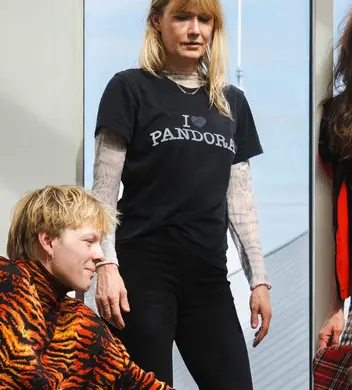


It’s been busy for Laura De Geest. She is performing in 'Mensen met problemen' (‘People with Problems’), a theatrical collaboration between the Flemish-Dutch collective Wunderbaum and NTGent. We meet between rehearsals to talk about politics and theatre, about acting and/or transforming, and about radicality and anti-heroes.
Mensen met problemen is an intriguing title. Could you give us a brief pitch of what the performance is about – which people and which problems?
We are bringing the work of German writer Sybille Berg to the stage. Between 2013 and 2017, she wrote and produced a total of four plays, which can be seen as a tetralogy. Menschen mit Problemen centres around one main character, a young woman, with three girlfriends and plenty of opinions about the outside world, even though she spends all her time indoors. Part (I) is about growing up, about the (female) body and, above all, about her mother. In part (II), the roles are reversed when she gets a daughter of her own. In Menschen mit Problemen (III), humankind plans to colonise Mars to escape this planet, which we have fucked up. To ensure procreation, only couples are allowed to join – so the woman organises auditions to find a man. Then, in the fourth part, we experience the final minute of her life from a hospital bed.
Each play was performed separately and described as monologue for multiple voices, or for one single twisted person
Originally, each play was performed separately and described as ‘a monologue for multiple voices, or for one single twisted person’. So in the German production, all actors played the same character, delivering the text unisono.
<img class="editorial-image-50-left" src="https://cdn.prod.website-files.com/61eebcc683107b99137f4423/6afd68981767ef35c190b50f_IMG_8586-bewerkt.avif"/>
<img class="editorial-image-50-right" src="https://cdn.prod.website-files.com/61eebcc683107b99137f4423/6afd689a7b45b12f7bec9f8c_IMG_8574-bewerkt.avif"/>
Berg is not very well known in Belgium. What makes staging her work so worthwhile?
She is a writer people really need to get to know. At one point in the third play, she describes the state of the world, saying that ‘executions are being livestreamed’. That is exactly what Trump recently wanted to do in Texas. As a writer, you can make up all sorts of things, but someone who, fifteen years ago, could already see the moral depths to which we would sink deserves to be honoured.
Someone who, fifteen years ago, could already see the moral depths to which we would sink deserves to be honoured
Over the last decades, a lot of theatre has been made about important issues. But these productions are often closely tied to the identity and personal story of their creator – which also means these productions are fundamentally less widespread, since these stories cannot simply be retold by someone else. Berg, on the other hand, has managed to capture the complexity of the world and take a political stance through a radical theatrical form that dodges the conventional format of identity theatre.
<img class="editorial-image-50-left" src="https://cdn.prod.website-files.com/61eebcc683107b99137f4423/6afd68981767ef35c190b512_IMG_8551-bewerkt.avif"/>
<img class="editorial-image-50-right" src="https://cdn.prod.website-files.com/61eebcc683107b99137f4423/6afd689924dc3f690a99cac7_IMG_8549-bewerkt.avif"/>
How do you approach that radicalism?
You can't soften concrete. And that's what these texts are.
But even though the polyphonic monologue of the original German production is a very clear and radical theatrical form, we deliberately chose to look for other ways of performing the plays, condensed into one, and with more interaction with the audience.
You can't soften concrete. And that's what these texts are
So rather than having all four performers play the same character, we shift between different guises. In the first part, we all play the ‘I’ together – this is where we remain closest to the original. In the second part, however, we play daughters; in the third, the men coming to audition; and in the fourth, we return to that same ‘I’ but this ‘I’ is fragmented across different moments in time.
<img class="editorial-image-50-left" src="https://cdn.prod.website-files.com/61eebcc683107b99137f4423/6afd68978de0bc1a10ec3b22_IMG_8511-bewerkt.avif"/>
<img class="editorial-image-50-right" src="https://cdn.prod.website-files.com/61eebcc683107b99137f4423/6afd68987d7d32a979be10ee_IMG_8783-bewerkt.avif"/>
I read that, as an actor, you are not merely looking to transform into a role. How do you reconcile that with the format of this adaptation, and the decision to deconstruct the original multiple/singular protagonist?
When we started rehearsing the third part, our automatic response was to lower our voices and adopt a broader stance to act more manly. But that wasn't interesting at all. On the contrary, we had to stay much closer to ourselves. This is a valuable lesson: sometimes you need far less transformation than you think to recognise yourself in someone else.
In that sense, I find the transformation that takes place within you when you encounter a particular work far more interesting than, say, how convincingly you can transform yourself into an old man.
Recently, I spoke up to a man who took up way too much space and made everybody feel uncomfortable. I realised it was Sybille Berg who encouraged me in that moment
Recently, during a theatre performance, I spoke up to a man who took up way too much space and made everybody feel uncomfortable. I realised it was Sybille Berg who encouraged me in that moment. I would never have dared to do that if I hadn't been working with this material.
<img class="editorial-image-50-left" src="https://cdn.prod.website-files.com/61eebcc683107b99137f4423/6afd68988df9125358933621_IMG_8555-bewerkt.avif"/>
<img class="editorial-image-50-right" src="https://cdn.prod.website-files.com/61eebcc683107b99137f4423/6afd6897a9ee39b5c73847d8_IMG_8618-bewerkt.avif"/>
Do you hope to bring about a similar transformation in the audience? Do you think spectators will recognise themselves in Berg's work?
I think it will go back and forth a bit. That's also what I like about this play. It is deeply ambivalent – she is such an ambiguous character. I find that interesting, because anti-heroes, especially female anti-heroes, are not easy to find.
Also: Berg spares absolutely no one: not men, but certainly not women either; not right-wing fascists, but neither the left-wing elite. There is a particular tension here, too, given that theatre audiences are generally made up of a left-wing elite. At the same time, Berg is absolutely hilarious. I often call her Bridget Jones on cocaine. (laughs) The whole thing is incredibly funny. So either people get the humour, or everybody goes home deeply offended. (laughs)
Female anti-heroes are not easy to find
But for the sake of radicalism, I think it's good that we're taking that risk. I'm grateful that, through this collaboration, we're working within a system that allows us to take the risk of staging the work of Sybille Berg. But that system is under pressure today. Without subsidies, you simply can't take these kinds of risks: we'd be doing Cats next year. Because then you start making theatre for commercial reasons, rather than simply out of love for the material… which is the case here.
<div class="editorial-banner"> <div class=“editorial-credits”>@lauradegeest<br>@acteursgroep_wunderbaum<br>@ntgent<br><br>Find the full list of tourdates here!</div>

Different Class works with the interest of their community at heart.
Our work’s purpose is to foster a solid network for independent artists, those who love them, and those who want to support them. Become a member to contribute to the local Belgian art scene.


Our membership


