


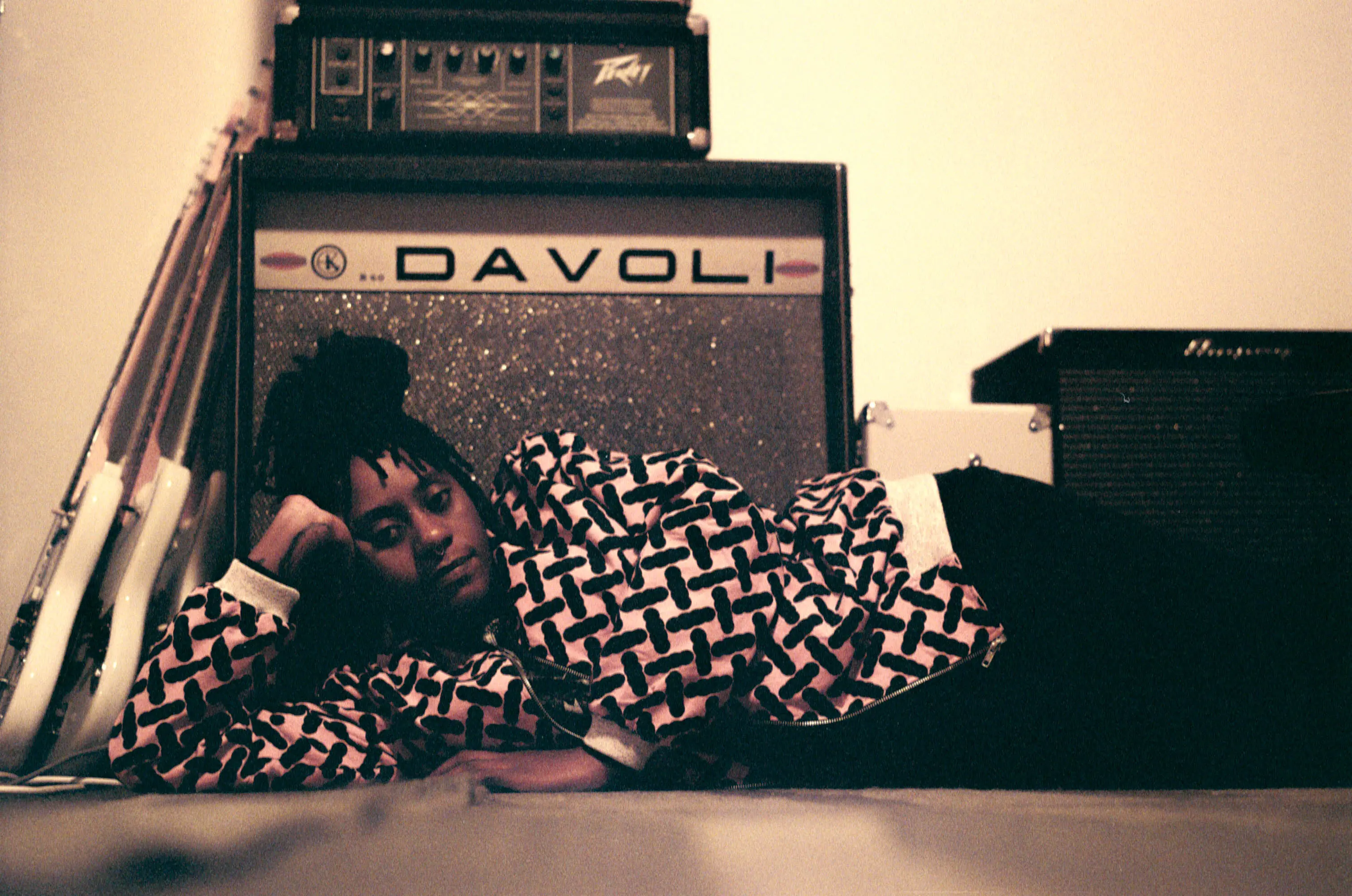

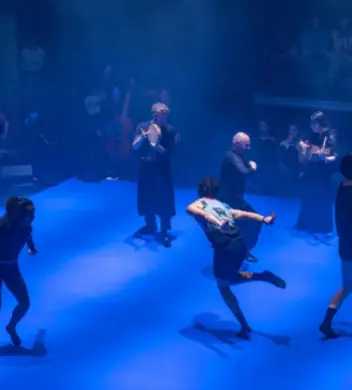


This season, DE SINGEL invites bassist and performer Farida Amadou, alongside fellow musicians and friends, for Radical Listening, a two-day residency taking place in April 2027 and, in October 2026, for her performance with Louis Vanhaverbeke, during the festival Shifting Sounds. Farida’s approach to performance and music steps outside traditional practice. Seventeen years ago, Farida picked up a forgotten bass in her home and started playing. She viewed the instrument in its raw form — a wooden box with strings — and began searching for unconventional ways to use it. Farida’s practice leaves us with a sense of possibility: music as a space for freedom and hope.
You’re bringing together West African music, European improvised music and experimental approaches; how do these different musical languages meet in your work?
That’s a big question. As you can imagine, being African but born in Belgium, and without much knowledge of my own musical culture from Niger, I only heard this music from age five to 20, because my mother was listening to a lot of tapes from West Africa.
And then I met people who played improvised music, and European improvised music is something in itself. So, because I only started to think about merging the two genres last year, I still question whether I can make it work, but I get a lot of motivation from my closest collaborators. There is a way to compose music instantly, like giving some kind of direction without putting limits or giving too many boundaries to people — just playing with patterns together.
There is a way to compose music instantly
At the end of the day, what is improvised music anyway? When you listen to West African music from the 80s and 90s, and even now, most of the albums were created by people who would improvise together and just press record. So our definition of what improvised music is here is completely different from theirs.
I had to let go of the idea that it wouldn’t be possible to merge these two genres, because there is a common aspect between them, just different cultures. It’s impossible to predict how the performance will turn out, which is why I love playing this type of music. It’s about being all together in a space, sharing who we really are, because that is what improvised music is to me: it’s like going somewhere, setting up, looking at each other, just starting and creating this bubble and this energy with the audience.
<img class="editorial-image-50-left" src="https://cdn.prod.website-files.com/61eebcc683107b99137f4423/6aa130cc102fa7661ee15426_DC_Farida-Amadou_LQ_28.avif"/>
<img class="editorial-image-50-right" src="https://cdn.prod.website-files.com/61eebcc683107b99137f4423/6aa130cbc903c16a95f78221_DC_Farida-Amadou_LQ_29.avif"/>
What does it actually mean to radically listen with an audience, and where do moments of silence fall into this shared experience?
It’s about letting go of certain ideas that you have about a type of music, and just entering the room ready to let go of your day, to let go of your problems, and just be in the moment with the people who are surrounding you.
We don’t talk enough about how our bodies vibrate, and that is why I love playing with an audience and not for an audience. And I make this distinction because I see the audience as part of the band. So we need them to create this energy. It’s like a shared experience to me, and that is what I mean by radical listening: it’s to listen with our bodies too.
Silence creates room for us to hear our bodies vibrating
To me, silence is definitely part of instant composing, because improvised music is unpredictable; we cannot predict the silent moments either. Each one of the musicians will decide when they want to play their instruments. Silence creates room for us to hear our bodies vibrating. Sometimes we have a big group, and you get to a point where we all stop together, like a perfect composition, and then go into something else right after.
This makes me think of when years ago, I learned sign language, and I had a teacher who came to one of my gigs, and he was deaf. At the end of the gig, he expressed to me that he enjoyed the show by rubbing his belly. It was a very special way to let me know that he loved the concert by feeling the vibrations — not especially hearing them, but feeling them in his own body.
<img class="editorial-image-50-left" src="https://cdn.prod.website-files.com/61eebcc683107b99137f4423/6aa130cbb075dd148c220731_DC_Farida-Amadou_LQ_23.avif"/>
<img class="editorial-image-50-right" src="https://cdn.prod.website-files.com/61eebcc683107b99137f4423/6aa130cb8eedad7930511123_DC_Farida-Amadou_LQ_25.avif"/>
How do you see the two different days of the residency connecting?
There will be musicians who will be playing on both days, and so will I. The way I see things is that one day will probably be more electric and the second day will be more acoustic. But I urge people to come both days because it’s going to be a different experience each time, while still being very sonic and full of energy.
I want people to leave feeling like they’ve experienced something special. The musicians I work with really want to give something through their art, rather than simply being there to play music. There’s also a sense of love and gratitude in what we do, an awareness that we are very lucky to be doing this today. And this kind of music has always been political for a reason, and I don’t think that’s going to change.
The musicians I work with really want to give something through their art, rather than simply being there to play music
Since improvisation is always an experiment, what are you currently curious to experiment with?
I’m currently working on this project that I created only with electronics. It’s called Darwinian 1.0. It’s like going back to the roots because I’m using samples from Niger.
I had this moment where, looking at how much war and damage is taking place now, made me question whether humans from the Stone Age discovering fire were smarter than we are right now, you know? I started this project eight months ago. I played it solo maybe three times and did it with a drummer friend from Belgium, Egon Wolfson, who I hope to collaborate with again.
I absolutely believe anyone can explore with an instrument
So what I’m very curious about is using all of these machines, without a lot of control, because that’s the way I like doing things. Having acoustic instruments accompanying me in this electronic world will be new to me.
I know some people would disagree with me, but I absolutely believe anyone can explore with an instrument. I wouldn’t say improvising in a group right away, but I think it would benefit the world if everyone experienced a bit of art.
<img class="editorial-image-50-left" src="https://cdn.prod.website-files.com/61eebcc683107b99137f4423/6aa130ca55b1a8ec2a21e12d_DC_Farida-Amadou_LQ_15.avif"/>
<img class="editorial-image-50-right" src="https://cdn.prod.website-files.com/61eebcc683107b99137f4423/6aa130cb7da1d4d20eebd64f_DC_Farida-Amadou_LQ_08.avif"/>
And what have you been listening to lately?
It’s funny you ask this because my sister just released an album! Her name is Mya Lee and the album is called X. It’s not because she’s my sister [laughs], but I find her music very interesting. It’s something between hip hop and 90s R&B, mixed with experimental sounds. And other than that, I’ve been listening to this artist from Chicago, Ben LaMar Gay, who I really like. His last album, Yowzers, is really good!
What are the themes and experiences that inspire your work, and what would you like to share with the audience through the shows?
I mean, don’t we always feel like what we want to express is kind of obvious, just like being ourselves? But I would say that for me, already, being a Black woman, playing this music all over Europe, and even beyond, is saying a lot. But I would love for younger musicians, whoever they are, to be able to feel like they can be whoever they want to be. For me, it’s about freedom and building confidence in achieving whatever we set as a goal. If you have a little Black girl who’s like, ‘Oh, I would love to be a musician,’ while she’s at my gig, I would be very happy.
<div class="editorial-banner"> <div class=“editorial credits”>@___fariiiiiiiida<br><br>20+21.10.2026<br>Soil Biographies: Farida Amadou / Louis Vanhaverbeke / LOD (Shifting Sounds)<br><br>14+15.04.2027<br>Radical Listening: Farida Amadou & friends<br>Antwerp, DE SINGEL<br><br>desingel.be</div></div>

Different Class works with the interest of their community at heart.
Our work’s purpose is to foster a solid network for independent artists, those who love them, and those who want to support them. Become a member to contribute to the local Belgian art scene.
Our membership


