


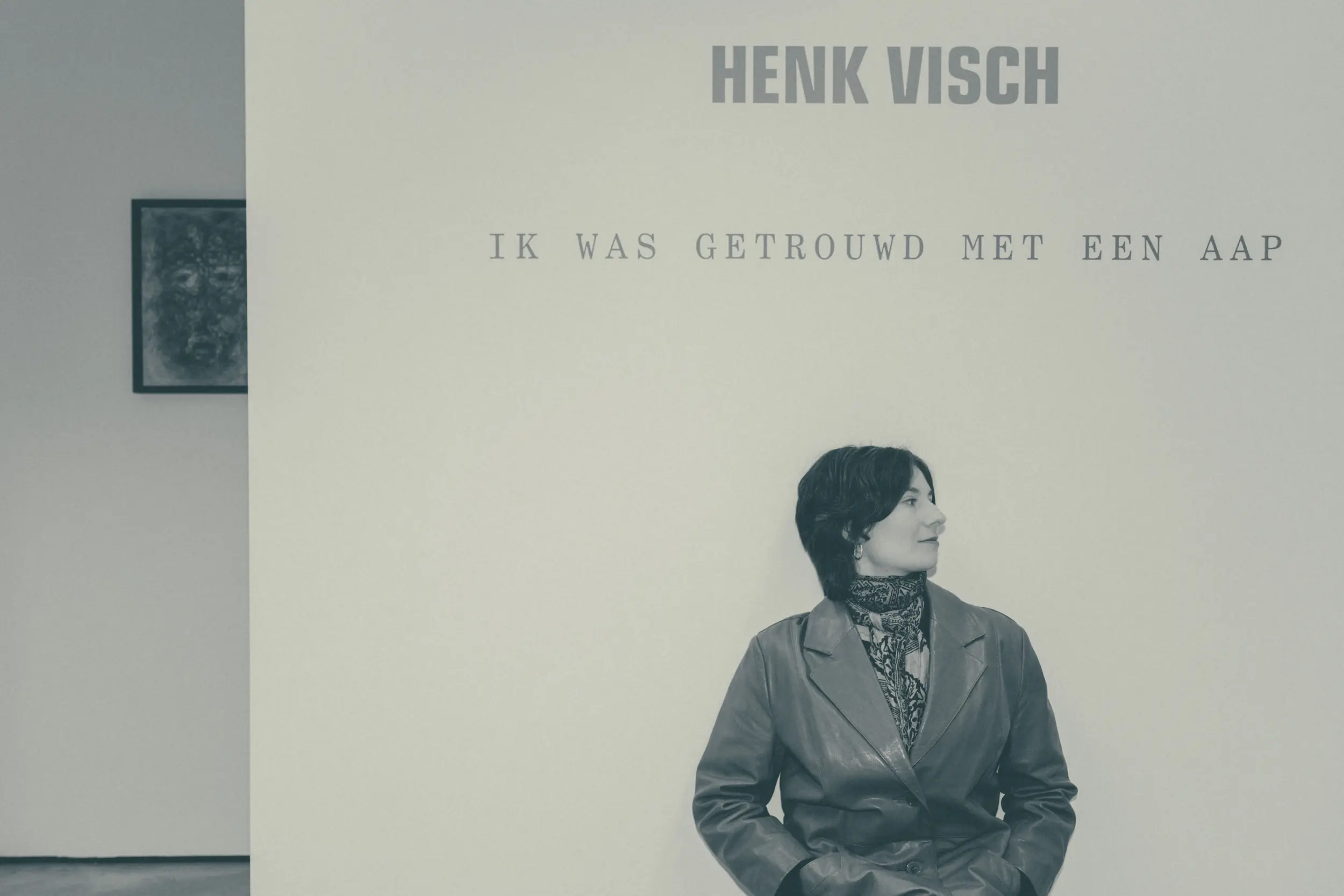


What makes a space inviting, unsettling or familiar? Together with writer and poet Anne Marijn Voorhorst, we visited Be-Part’s exhibition 'Ik was getrouwd met een aap' [I was married to a monkey] by Henk Visch. His sculptures opened up a conversation about the body, the spaces we inhabit and the strangeness of everyday life. Anne Marijn reflects on finding meaning in the eerie details of mundane surroundings, and on what becomes visible when we dare to look closer.
What was your first impression of Henk Visch’s exhibition, starting with its title, I was married to a monkey?
The title immediately made me wonder who is speaking. Is it a human, a creature, or something else? Together with the sculptures, it feels eerie, but also playful and humorous. The past tense made me think that something had gone wrong: perhaps they got divorced, or the monkey died. It feels as though an entire life is opening up, with someone looking back on an adventurous past.
<img class="editorial-image-50-left" src="https://cdn.prod.website-files.com/61eebcc683107b99137f4423/6ae1c733a9dcd8bbfd4c8f2f_DifferentClass_%40MAYLISTERKENDRIES-9514.avif"/>
<img class="editorial-image-50-right" src="https://cdn.prod.website-files.com/61eebcc683107b99137f4423/6ae1c732f5eb6efc4fa43bf9_DifferentClass_%40MAYLISTERKENDRIES-9962.avif"/>
You write from bodily experiences and the spaces they inhabit. Did you recognise something of your own practice in Visch’s sculptures?
I felt connected to the way he presents the body. He describes it as an inhabitant of a dark world, almost as if the body itself were a space, with tunnels and passages. Perhaps there is something dark about being inside a body you cannot leave, and the difficulty of connecting with another person or another body.
Perhaps there is something dark about being inside a body you cannot leave
The sculptures’ poses look uncomfortable, as though the figures are forcing themselves into position. Yet they are also smooth and flexible. That contrast between discomfort and lightness is interesting.
<img class="editorial-image-50-left" src="https://cdn.prod.website-files.com/61eebcc683107b99137f4423/6ae1c734f5eb6efc4fa43c73_DifferentClass_%40MAYLISTERKENDRIES-9583.avif"/>
<img class="editorial-image-50-right" src="https://cdn.prod.website-files.com/61eebcc683107b99137f4423/6ae1c7327c4a0dedbb92f538_DifferentClass_%40MAYLISTERKENDRIES-9917.avif"/>
Your poetry explores shopping malls, caves and other spaces. What draws you to places that can feel both familiar and unsettling?
I write immersing myself in spaces where there is a clash: you try to belong, connect with others or feel safe, but something doesn't quite work. Shopping malls are interesting because they seem familiar and predictable. But when you spend hours there, noticing everything, they become overwhelming and unsettling. The bright light, the slogans and the consumerism can feel suffocating.
I wanted to counter that feeling with spaces that were more inviting, so I researched caves and underground places. I was interested in cave paintings as a form of communication, just as shopping malls surround us with slogans and store names. I also drew on the image of my teenage bedroom, a hidden space where you could write a diary and explore your deepest secrets and desires.
<img class="editorial-image-50-left" src="https://cdn.prod.website-files.com/61eebcc683107b99137f4423/6ae1c7329933c26f26af11eb_DifferentClass_%40MAYLISTERKENDRIES-9621.avif"/>
<img class="editorial-image-50-right" src="https://cdn.prod.website-files.com/61eebcc683107b99137f4423/6ae1c7326a9b599e6349a3bc_DifferentClass_%40MAYLISTERKENDRIES-9700.avif"/>
You’ve said that everyday life can feel strange when we stop to examine it. How do you deal with the eeriness that is felt in that?
I think the eeriness is inevitable. I was put on this earth without asking to be here, and then I have to deal with it. The body is a fact: you are inside it, and it has to deal with all the layers of space and expectation placed upon you. I want people to notice how strange our everyday routines are. We conform to things that are actually quite random, but we could organise life differently. Visch writes that ‘no is the new yes’. I find that interesting as he explains that rejecting something, even in everyday life, is an expression of free will. I think that recognising that eeriness rather than escaping it can lead us to new possibilities.
I think the eeriness is inevitable
<img class="editorial-image-50-left" src="https://cdn.prod.website-files.com/61eebcc683107b99137f4423/6ae1c7355df3053262a3fd13_DifferentClass_%40MAYLISTERKENDRIES-9823.avif"/>
<img class="editorial-image-50-right" src="https://cdn.prod.website-files.com/61eebcc683107b99137f4423/6ae1c7340742a17c407cfd96_DifferentClass_%40MAYLISTERKENDRIES-9774.avif"/>
How do the spaces you explore influence your poetry, and can you tell us about your upcoming collection, Vertrekken?
I don't see many things as abstract. Everything is speaking quite loudly; you just have to dare to look and listen. Poetry helps me bring observations together and make something that might seem abstract more concrete. A single, seemingly dry observation can create an entire universe on the page.
I don't see many things as abstract. Everything is speaking quite loudly; you just have to dare to look and listen
<img class="editorial-image-50-left" src="https://cdn.prod.website-files.com/61eebcc683107b99137f4423/6ae1c73239f2b77a5651ddcc_DifferentClass_%40MAYLISTERKENDRIES-9890.avif"/>
<img class="editorial-image-50-right" src="https://cdn.prod.website-files.com/61eebcc683107b99137f4423/6ae1c7325c5c5488ad246b72_DifferentClass_%40MAYLISTERKENDRIES-9876.avif"/>
In my poetry, I combine accessible, everyday language with something gritty and dark humour. I like the clash between the bold and the playful, the eerie and the light. In Vertrekken, I removed the individual poem titles, keeping only chapter titles. The word ‘vertrekken’ can mean both ‘leaving’ and ‘spaces’, and I wanted the chapter titles to act like doors, inviting readers to enter the texts as they would enter a space.
I like the clash between the bold and the playful, the eerie and the light
I also find freedom in darkness. We are often taught that dark places are dangerous, while brightly lit spaces seem safe. But darkness can quieten social norms and offer room to express yourself. Shopping malls are complicated in that sense: their consumerism can be disturbing, yet they have also been a refuge for me, offering structure and a feeling of protection. That contradiction is what interests me: a space can unsettle us and comfort us at the same time.
<img class="editorial-image-50-left" src="https://cdn.prod.website-files.com/61eebcc683107b99137f4423/6ae1c732726f7411cc31f726_DifferentClass_%40MAYLISTERKENDRIES-9864.avif"/>
<img class="editorial-image-50-right" src="https://cdn.prod.website-files.com/61eebcc683107b99137f4423/6ae1c732c13e49e1ffea124c_DifferentClass_%40MAYLISTERKENDRIES-9910.avif"/>
<div class="editorial-banner"> <div class=“editorial-credits”>@annemarijnvoorhorst<br>@bepart_platform<br><br><br/>Henk Visch - Ik was getrouwd met een aap<br>until 29.11.2026<br>Kortrijk, Be-Part<br/>be-part.be<br><br>Anne Marijn Voorhorst - Vertrekken<br>available through Poeziecentrum</div></div>

Different Class works with the interest of their community at heart.
Our work’s purpose is to foster a solid network for independent artists, those who love them, and those who want to support them. Become a member to contribute to the local Belgian art scene.
Our membership


