


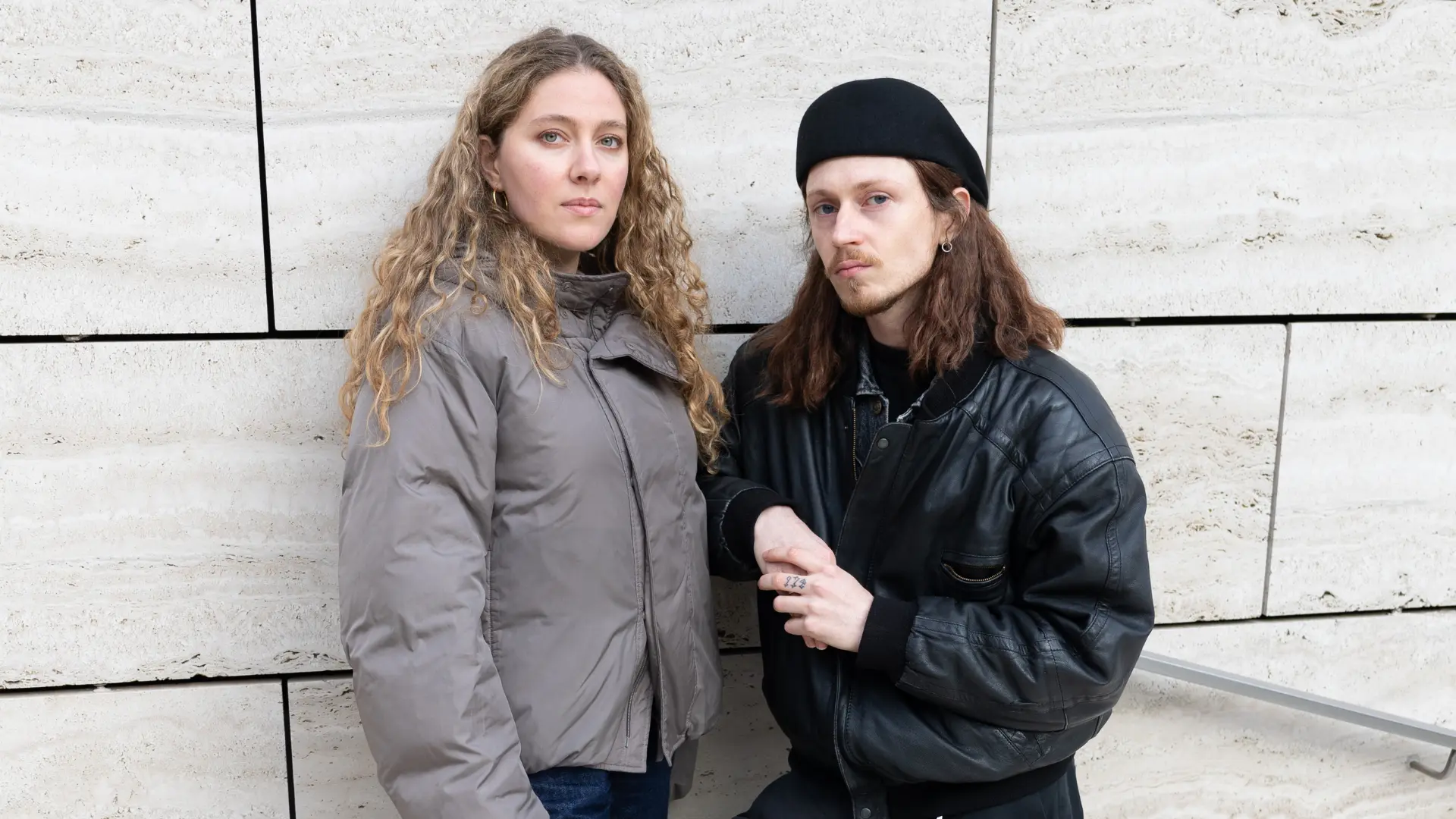


Shift Entity, the united practice of Axelle Devaux and PC Malet, moves across writing, installation, fiction and sensory experience. Rooted in shared research and extended collaborative networks, their work constructs speculative spaces that feel both familiar and slightly out of joint. After visiting Alicja Kwade’s Dusty Die at M Leuven together, we spoke about some topics both this exhibition and Shift Entity’s work tackle: beginnings, layered realities, memory, collaboration and the quiet ways perception can shift.
Before we talk about Kwade, can you tell me how you met and how Shift Entity began?
SE: I’m Axelle. I first studied art in Bourges, mostly video and writing, then moved to Brussels for my master’s at the Académie Royale, where PC and I met.
And I’m PC. I grew up on Reunion Island, studied graphic design when I was eighteen, then art school in France, and later the CARE master's in Brussels. We started talking and writing together at the end of our first year and realised that our ways of imagining things matched. Little by little, this writing and thinking became our practice. We both come from different places, but our stories met somewhere in the middle, so Shift Entity became this space where everything can shift and expand.
<img class="editorial-image" src="https://cdn.prod.website-files.com/61eebcc683107b99137f4423/6938398376b5df8fb08bdf49_8D8A6813%20copie.avif"/>
Writing appears to be the first material you work with. What happens in that phase?
SE: It always begins with writing and research. We take a topic and go very deep, collecting images, documents, scientific facts, and personal memories. From that, we begin to write a story. Writing gives us a structure, a world, a fiction that is not ‘unreal’ but true in another way.
We describe everything: smells, gestures, landscapes, the temperature of a room, and the feelings of a fictional character. The more precise the text becomes, the more real it feels to us. Only after that do we start drawing or thinking about materials. The installation grows from the writing, never the other way around.
When we discovered the online practice of shifting realities, we became fascinated by its structure
Just like Alicja Kwade’s, your practice deals a lot with parallel realities and layered time. Where does this come from?
SE: When we discovered the online practice of shifting realities, we became fascinated by its structure. People who practise it write extremely precise frameworks to project their consciousness into fictional or parallel worlds. Four realities coexist, and you can place elements in each of them. We do not practise shifting personally, but the method resonated with us. It reminded us of the ‘thick present’ of Donna Haraway, where time is not linear but layered like geological strata. It lets us use anachronisms without them being mistakes. And we were moved by the emotional reasons people practise shifting, many of them want to leave a life where they do not feel good. We wanted to use the same tools, but to create more positive possibilities, maybe even utopias.
It reminded us how perception works on a very physical, human scale
<img class="editorial-image-50-left" src="https://cdn.prod.website-files.com/61eebcc683107b99137f4423/693839837fe8cbc4d03a4898_8D8A6802%20copie.avif"/>
<img class="editorial-image-50-right" src="https://cdn.prod.website-files.com/61eebcc683107b99137f4423/693839834b7662473eb787db_8D8A6784%20copie.avif"/>
During our walk through Dusty Die, something already ‘shifted’ in the first room. What happened there?
SE: It created a kind of sensory reset. You enter, and your eyes need time to adjust, and the longer you stay, the more you see. The sound, the reflections, the dizziness… it reminded us how perception works on a very physical, human scale. We try to do something similar, but with other tools. Kwade works with mirrors, stones, and gravity. We often use temperature, scent, or narrative. But the moment of slight disorientation, where you do not quite trust your senses, that is something we also look for. A small shift that changes the whole experience.
<img class="editorial-image" src="https://cdn.prod.website-files.com/61eebcc683107b99137f4423/69383a164b99b38abfb62bd4_8D8A6795%20copie.jpg"/>
Collaboration comes up a lot when you speak. How do you approach it?
SE: We think about collaboration from the very beginning of a project. We do not want to ask someone for a technical service. We want to build something together, from the inside. When we worked with the sound artist Émilie Lachaume, she created a fifteen-minute loop for one installation. For her, it was about ghosts. We had not thought about ghosts at all, but it fitted perfectly with the atmosphere. Every collaborator brings a new layer. Even when Axelle started studying textiles in Paris, we felt it would eventually become part of our practice. Shift Entity is not fixed. It keeps absorbing new experiences, new voices.
Truth is not about proving something. It is something you feel
<img class="editorial-image-50-left" src="https://cdn.prod.website-files.com/61eebcc683107b99137f4423/69383aecfff538e84d6b346d_8D8A6791%20copie.jpg"/>
<img class="editorial-image-50-right" src="https://cdn.prod.website-files.com/61eebcc683107b99137f4423/693839831625a7fcf8411c58_8D8A6771%20copie.avif"/>
Your installations often play with memory, truth and sensory thresholds. Kwade also questions the boundaries of perception in her work. How do you think about truth inside your fiction?
SE: For us, truth is not about proving something. It is something you feel. A smell connected to a memory can be more truthful than a fact. A voice in a room can function like an archive. We try to make everything as precise as possible in the writing, because that precision helps the work feel credible. In our project about the volcanologists Katia and Maurice Krafft, we mixed reality and fiction. People asked us, ‘Is this part true?’ and they hesitated. We like that moment. Some real things seem fictional, and some fictional things feel real. We enjoy that space between the two. It says something about how we live now, and how we look for meaning.
<img class="editorial-image-50-left" src="https://cdn.prod.website-files.com/61eebcc683107b99137f4423/693839832870f18cfaf674a7_portrait.avif"/>
<img class="editorial-image-50-right" src="https://cdn.prod.website-files.com/61eebcc683107b99137f4423/69383a2101f97e0943bec49f_8D8A6845%20copie.avif"/>
If you could add one new layer to the many realities you work with, what would it be?
SE: Maybe a reality where everything is on the same scale. No hierarchy between humans, machines, animals, or plants. More equality, less competition. Something closer to how ecosystems really work. Something connected to childhood landscapes. For me, (PC) volcanoes are a place where I feel safe, even if they are dangerous. I would like to imagine a world where that energy can be part of everyday life. For me (Axelle), I think about adding comfort into fiction. Not escape, but a place to breathe inside a story.
<div class="editorial-banner"> <div class=“editorial-credits”>@shift_entity</div></div>

Different Class works with the interest of their community at heart.
Our work’s purpose is to foster a solid network for independent artists, those who love them, and those who want to support them. Become a member to contribute to the local Belgian art scene.
Our membership


