


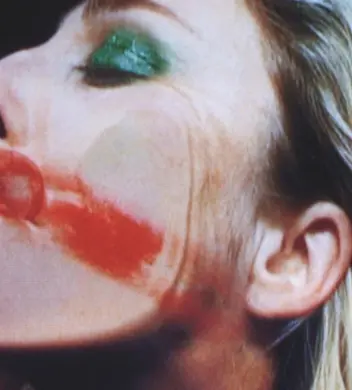


In a world flooded with images, who gets to define beauty? At Bozar, the exhibition Picture Perfect. Beauty through a Contemporary Lens, tackles that question through photography and video. From the 1960s to the age of social media, artists capture and challenge the ideals that shape how we see ourselves. Together with Belgian-Brazilian stylist and creative director Priscilla Nollé, we navigate this image-saturated landscape.
We’re surrounded by images of bodies, faces and beauty rituals. What strikes you first?
It’s clear that the exhibition wants to say something about what beauty means today. In a way, that’s old news, but at the same time, it’s still new news, because beauty standards haven’t gone away. Most people don’t even realise how much they communicate through their appearance. The way you dress already says something about your work, background, community… Everything revolves around looks, even if you think you’re not part of it.
Everything is about how you look, even if you think you’re not part of it
<img class="editorial-image-50-left" src="https://cdn.prod.website-files.com/61eebcc683107b99137f4423/69c153b4295e196711c11be1_PicturePerfect%40BOZAE_DIFFERENTCLASS-20.jpg"/>
<img class="editorial-image-50-right" src="https://cdn.prod.website-files.com/61eebcc683107b99137f4423/69c153b6d7cb08fea8084e8e_PicturePerfect%40BOZAE_DIFFERENTCLASS-22.avif"/>
Many works here question beauty standards. Has your idea of beauty changed since you started working as a stylist and creative director?
I’ve been doing this for about ten years. It started in a playful way, just experimenting and creating things with friends. Over time, it grew into something more serious and eventually became my job. Along the way, I worked with celebrity stylists and on films and commercials, before starting independently about three years ago.
Over the years, my perspective has changed a lot. When I was working on editorials, everything had to be perfect - clothes, hair, makeup. A wrinkle could feel like a disaster. Lately, I’ve moved away from that. I’ve almost become a bit anti-fashion. I prefer telling stories inspired by a conversation with a friend, an artwork or something I experienced. Fashion is playtime for me. I don’t want to feel restricted or put in boxes. That’s how people treat fashion too often.
Fashion is playtime for me. I don’t want to feel restricted or put in boxes
<img class="editorial-image" src="https://cdn.prod.website-files.com/61eebcc683107b99137f4423/69c153b633d6b896e944667a_PicturePerfect%40BOZAE_DIFFERENTCLASS-26.avif"/>
Where do your ideas usually start as a stylist - with clothes, people, a mood?
It depends on the project. For a movie or commercial, the story’s credibility comes first, so I research communities, eras and cultures to understand the world I’m depicting. With artists, they often already have a style or an idea. The main questions I ask are: How do you want to be seen? How do you want to feel when people look at you? They sometimes come with references - things they like from other artists - but for me, it’s really about: Who are you?
<img class="editorial-image-50-left" src="https://cdn.prod.website-files.com/61eebcc683107b99137f4423/69c153b639e8d37e87d30e72_PicturePerfect%40BOZAE_DIFFERENTCLASS-02.avif"/>
<img class="editorial-image-50-right" src="https://cdn.prod.website-files.com/61eebcc683107b99137f4423/69c153b3bdff6cb9b9f592c6_PicturePerfect%40BOZAE_DIFFERENTCLASS-18.jpg"/>
This exhibition spans from the 1960s to today. Do you think our relationship to beauty standards has changed in the age of social media?
There are many more references around us today. Images circulate everywhere, and it’s hard not to be aware of them. I notice it myself, as well as in the people I work with: sometimes they want to look a certain way or feel insecure about parts of their body. That’s why I say that as a stylist, you also have to be ready to be a bit of a therapist. You talk about someone’s body, and that can become very personal. But it can also be a beautiful moment, because you’re creating something together and sharing an honest conversation in the process.
As a stylist, you also have to be ready to be a therapist
<img class="editorial-image" src="https://cdn.prod.website-files.com/61eebcc683107b99137f4423/69c153b6aeb47bace909eec9_PicturePerfect%40BOZAE_DIFFERENTCLASS-11.avif"/>
Do you feel that, as a stylist, you can play a role in changing these beauty narratives?
I try to show people that they can be more than the little box they’ve put themselves in. But of course, it’s a process. At the end of the day, I’m just planting seeds, and what people do with them is up to them. Most adults lose the sense of freedom they had as a child. I mostly hope they can find that flow again, also through the way they dress. It’s not that serious. But too often, people don’t dress for themselves. That’s a shame.
<img class="editorial-image-50-left" src="https://cdn.prod.website-files.com/61eebcc683107b99137f4423/69c153b43df7237bb18645ce_PicturePerfect%40BOZAE_DIFFERENTCLASS-21.jpg"/>
<img class="editorial-image-50-right" src="https://cdn.prod.website-files.com/61eebcc683107b99137f4423/69c153b5e7e143576b9c6519_PicturePerfect%40BOZAE_DIFFERENTCLASS-05.avif"/>
What caught your eye in the exhibition?
A commercial by Sin Wai Kin with a horse. It reminded me of my childhood: my family has farms in Brazil, and I spent every summer there. For me, horse riding brings total freedom. It also connects to what I was saying about ‘boxes’: People might see me as a creative focused on clothes, but that’s one part. In Brazil, I’ll wear cowboy boots, simple jeans, a top and a cap. Through those clothes, I become another version of myself.
<img class="editorial-image" src="https://cdn.prod.website-files.com/61eebcc683107b99137f4423/69c153b6067d3a4c425eac36_PicturePerfect%40BOZAE_DIFFERENTCLASS-24.avif"/>
You describe yourself as an imaginadora, seeing possibilities everywhere. Does a show like this spark new ideas for you?
At the start of the exhibition, there was a video with 3D elements that I loved. For some, it might be a fantasy world, but for me, it felt like coming home. I draw inspiration from these things that I stumble upon by chance. My friends are a significant source of ideas as well. I try to involve them in projects as photographers, actors, or collaborators. I believe that it’s not going to work alone. The creative sector sometimes feels quite big and even a little lonely, so it’s important to surround yourself with people you feel good with creatively. When you find people where things flow naturally, the process becomes much more enjoyable.
<div class="editorial-banner"> <div class=“editorial-credits”>@prince.indgo<br>@bozarbrussels<br></div>

Different Class works with the interest of their community at heart.
Our work’s purpose is to foster a solid network for independent artists, those who love them, and those who want to support them. Become a member to contribute to the local Belgian art scene.
Our membership


