


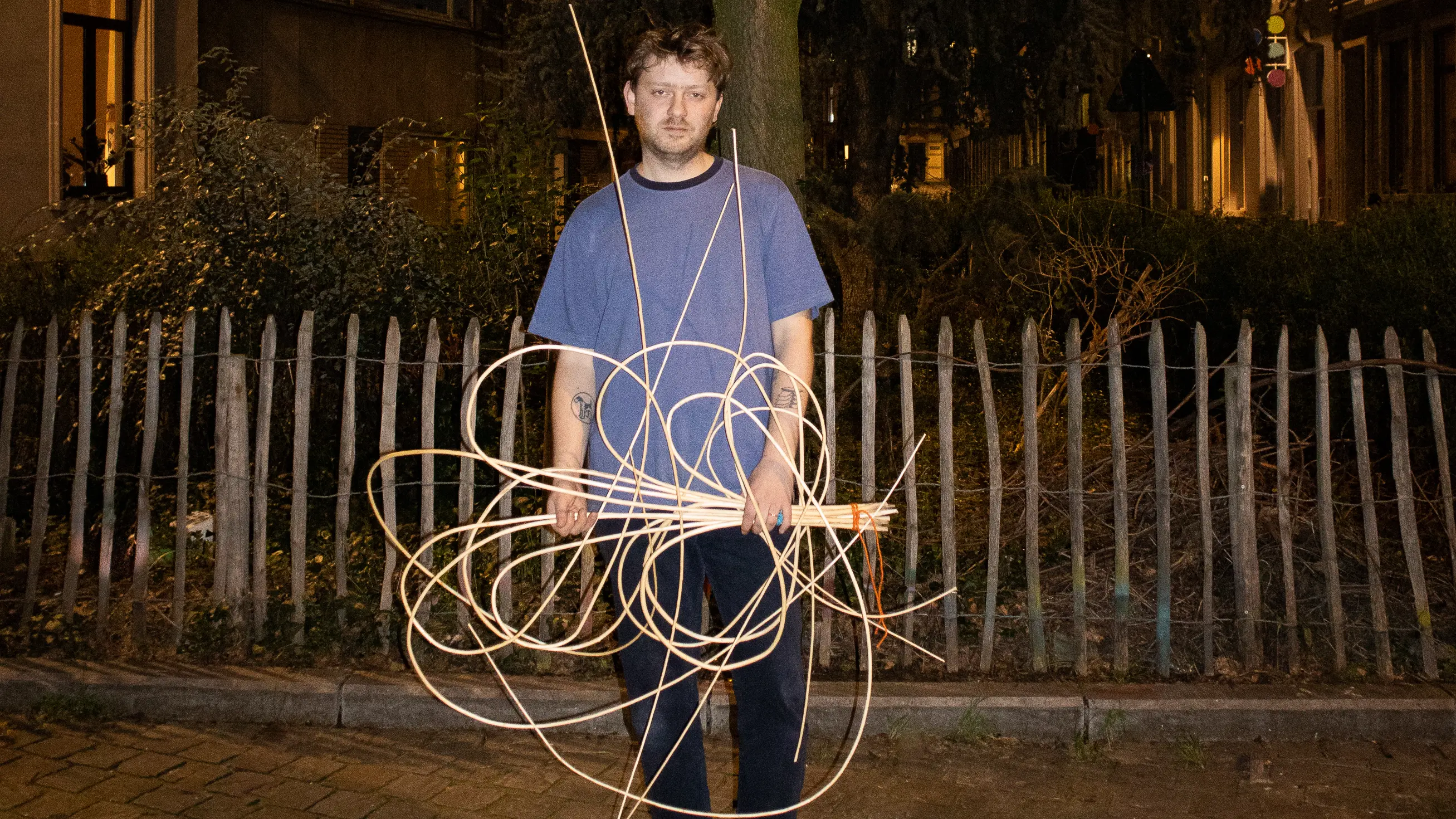


We met Vicente Fuenzalida Lafourcade in Brussels as he prepared for an upcoming project. Our conversation moved through storytelling, painting and the quiet patience of waiting. Raised in the south of Chile and now based in Belgium, the KASK fine arts graduate works with painting, wicker and installation to explore how meaning shifts over time. From childhood tales to suspended moments of stillness, his practice moves between memory, transformation and what he describes as the art of doing nothing while doing something.
How would you describe your practice?
I think I’m very connected to stories. All kinds of tales, but especially the popular ones that are told by word of mouth instead of being written down. Some stories I would hear as a child in the south of Chile would change as they were retold over the years by different people. Each person adds or removes something. I relate that to my paintings. When you tell a story, you become part of it. Sometimes you might invent parts of the story depending on who you’re speaking to. I work with my paintings in a similar way. The story and the painting both shift as I try to both carry the energy of how the tale transforms into the painting.
When you tell a story, you become part of it. The story mutates
<img class="editorial-image-50-left" src="https://cdn.prod.website-files.com/61eebcc683107b99137f4423/69b7dfa3b1199fd19d447f05_IMG_7962.avif"/>
<img class="editorial-image-50-right" src="https://cdn.prod.website-files.com/61eebcc683107b99137f4423/69b7dfa30abaf13013314618_IMG_7967.avif"/>
What was it like growing up in Osorno, and how did its stories shape you?
It's a small town called Osorno in southern Chile. There are forests surrounding the city, as well as many rivers and mountains. The city itself is kind of ugly, but you have this incredible landscape surrounding it, close to the Andes mountains. It’s known as the city of milk and meat; farming is the main activity. There is not much to do; we would just gather outside, with a lot of layers because it’s often cold and rainy. I’m fascinated by how myths change over time and how their ancient meanings can evolve into something contemporary. I like the symbolic interpretation of everyday things. I also just like the stories of real events told on the streets of a small town. Someone tells you something happened to a person. Then you meet that person, and they say, ‘No, that’s completely different’. The story mutates.
<img class="editorial-image-50-left" src="https://cdn.prod.website-files.com/61eebcc683107b99137f4423/69b7dfa3d8ec800f624b0ae2_IMG_7990.avif"/>
<img class="editorial-image-50-right" src="https://cdn.prod.website-files.com/61eebcc683107b99137f4423/69b7dfa3f7b53af98149c632_IMG_7978.avif"/>
How has your relationship with painting changed, especially since moving to Belgium?
I was trained as a painter in Chile. After school, I began experimenting with other materials, moving towards sculpture and installation. But when I came to Belgium, I no longer had my structure. In Chile, I had friends with workshops, tools, and materials. Here, I didn’t know where to buy things or how to organise that kind of production. So I kept things simple, and I returned to painting. But I also work with wicker, it’s very common in Chile. There’s actually an interesting story behind that. In the 1960s, the Chilean government introduced it so people in rural areas could have work during winter, when farming stopped, to distract them from drinking too much. When I looked into that, I discovered that wicker is very easy to find in Europe. I now combine my painting with wicker sculpture.
I now combine my painting with wicker sculpture
<img class="editorial-image-50-left" src="https://cdn.prod.website-files.com/61eebcc683107b99137f4423/69b7dfa356ed53926cb36f20_IMG_7973.avif"/>
<img class="editorial-image-50-right" src="https://cdn.prod.website-files.com/61eebcc683107b99137f4423/69b7dfa4d85376032a6227f3_IMG_8004.avif"/>
How did studying at KASK influence your work?
At first, it was challenging due to language, culture, and different ways of working. I really liked the programme because I found it very liberating. It’s funny because I didn’t originally plan to go into the painting department. My English wasn’t very good at the time, and when I met the programme coordinator, she asked me what I was doing. I said, ‘I’m painting,’ referring to what I had done back home, and she sent me to the painting department. It all worked out for the best because I found a new way of painting at KASK, with so much freedom. In Chile, my painting felt more planned. You design everything before starting. Here, you search within the process itself, and there’s more room to experiment. Now I work in layers. I make a painting, then completely cover it with white, and then I paint again. The parts I leave visible belong to the first painting. This allows me to have a moment of decision and a moment of labour where I just follow lines and am not forced to choose, and I really like that ease and freedom.
<img class="editorial-image-50-left" src="https://cdn.prod.website-files.com/61eebcc683107b99137f4423/69b7dfa5dcc1ff4e8c339d6a_IMG_8041.avif"/>
<img class="editorial-image-50-right" src="https://cdn.prod.website-files.com/61eebcc683107b99137f4423/69b7dfa5fb0b28a31744dceb_IMG_8015.avif"/>
Fishing became central in your graduation project Señuelo. What draws you to the suspended moment of waiting while fishing?
I used to go fishing with my father as a child in Chile. People don't fish in the cities, so it involved a lot of travelling to the mountains and to rivers. I really enjoyed this feeling of waiting, and this moment of silence with my father, just listening to nature. When I came to Ghent, I noticed that people can have the same moment, but after work, and surprisingly, in the city. So it came naturally to me for this project. I was thinking about how fishing operates through possibility: you cast something into the water, and you wait, not knowing what will happen.
Freedom can be found in these moments where you’re forced to wait
Freedom can be found in these moments where you’re forced to wait. You are doing something, but at the same time, you are doing nothing. When you sit still, you begin to notice other things around you. I’m really fascinated by activities that allow you to experience this.
Where is your practice taking you now?
I’m painting and trying to get more involved with the city and its context. I walk around a lot and notice things that end up in my paintings, like doors or metal window guards. They serve as an extra layer of protection, but they are also decorative. I’m also exploring art with memories, language, and how people speak in different contexts.
<img class="editorial-image-50-left" src="https://cdn.prod.website-files.com/61eebcc683107b99137f4423/69b7dfa51f4fed8a8f298d0b_IMG_8031.avif"/>
<img class="editorial-image-50-right" src="https://cdn.prod.website-files.com/61eebcc683107b99137f4423/69b7dfa6b898f3609b6a87d0_IMG_8034.avif"/>
Currently, I’m setting up an exhibition called Tomar Aliento, which translates to ‘take a breath’ with my friend Joaquin Lozano Niño de Zepeda. We decided to rent the space at Zsenne Artlab, go back to our early days in art school, and connect with what we dreamed of back then and what we are doing now. Joaquín moved from Chile to Spain, so it’s nice to circle back here in Brussels and collaborate. We both want to enjoy this time to create with different materials and reflect on different locations and practices through our friendship. I’m looking forward to seeing what will emerge in the coming days.
<div class="editorial-banner"> <div class=“editorial-credits”>@_vicentefuenzalida<br><br>Different Class and KASK & Conservatorium are joining forces on a series of artist portraits featuring their alumni. The school is organising an Open Day for potential new students on 26.04.2026.<br><br>schoolofartsgent.be</div>

Different Class works with the interest of their community at heart.
Our work’s purpose is to foster a solid network for independent artists, those who love them, and those who want to support them. Become a member to contribute to the local Belgian art scene.
Our membership


