


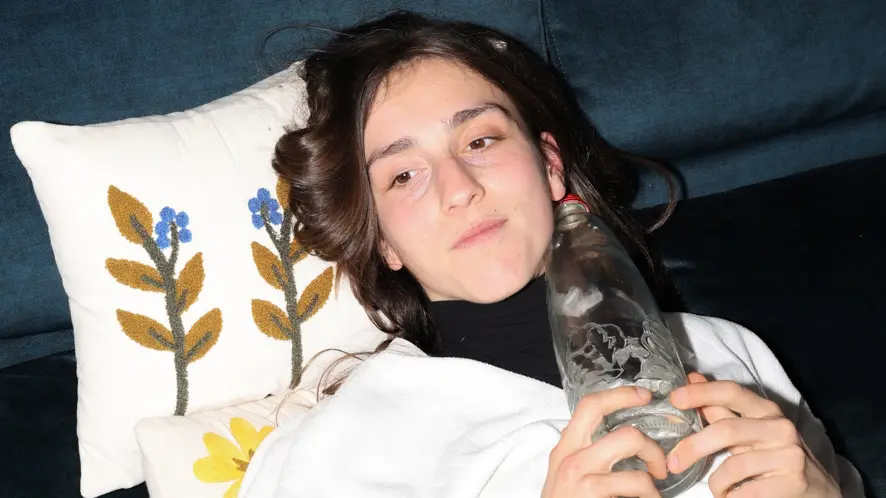


KASK & Conservatorium Alumna, Melody Van Gompel, creates from instinct. We spent a warm afternoon in her mother’s home in Brussels, a space she quietly associates with the womb. She imagines performing for human and non-human bodies alike — even for the smallest organism. Her work opens a vulnerable dialogue between performer and audience, turning the gaze inward to explore womanhood, desire and transformation. At its core is a fascination with the body’s raw responses: feeling first, before understanding follows.
What did you study at KASK & Conservatorium?
I studied Drama for five years and completed my Master’s over two years. Although my training is in drama, my artistic practice is really an entanglement of different forms. I work with movement, text, singing, music - everything begins from the body. My body is the starting point of creation.
I’m interested in creating other universes through decontextualisation: placing elements where they don’t ‘belong’ to create a sense of alienation that invites the audience to rethink what they see. It’s about decontextualisation - of images, of meaning, of expectations.
A kind of thread running through my work, which I call a ‘blue thread’ because blue feels right to me, is the attempt to transcend the body without losing its materiality. I’m interested in how we can move beyond fixed identities while remaining grounded in physical, human and non-human bodies. I want to explore how to deconstruct the body's binary and how we define and sense the contradictions that coexist within the same body. Rather than a paradox, I see this as a dialogue between what is inside, outside, above and beneath.
<img class="editorial-image-50-left" src="https://cdn.prod.website-files.com/61eebcc683107b99137f4423/6a0afa658d422fe8d8505d56_melody_ld-15.avif"/>
<img class="editorial-image-50-right" src="https://cdn.prod.website-files.com/61eebcc683107b99137f4423/6a0afa629d6e7a93cd8bb346_melody_ld-11.avif"/>
As you mentioned, you move between human and non-human bodies. What draws you to that space in between?
That space is full of potential for dialogue as well as a sense of nothingness, which I find abundance in — something that I’m still exploring. Not only through language, but through silence, sensation and presence. Silence itself can be very loud; it can suggest something without defining it.
I’m interested in deconstructing language and meaning
I’m not trying to define for the audience what to see. It’s more about sharing a space where something can emerge with all of us together in the same moment. Understanding doesn’t necessarily come through words; it can happen through the senses: through sound, smell, taste, or imagination.
I’m interested in deconstructing language and meaning. Words are constructions, and when you shift them, they open up new possibilities. That’s where this violent magic happens.
<img class="editorial-image" src="https://cdn.prod.website-files.com/61eebcc683107b99137f4423/6a0afa62c460985d96516518_melody_ld-7.avif"/>
When did you realise this was the direction of your practice?
It’s always been there. Creating was never really a choice; it was a necessity for me. As a child, I instinctively created other worlds to escape and to claim space for myself. I started with drawing, then moved into other forms. It all developed very instinctively. I didn’t decide on a method; I followed something that was already present. My work is very embodied - fleshy, even. I’m interested in inward movement: exploring the body from within, but without becoming fixed in it. I want to move through bodies, through transformation. Everything is in flux.
My work is very embodied - fleshy, even
When I say ‘body’, I don’t just mean human bodies. A word can be a body. A melody can be a body. Anything that can be sensed becomes a body somehow.
<img class="editorial-image-50-left" src="https://cdn.prod.website-files.com/61eebcc683107b99137f4423/6a0afa61921e5a4bd676f108_melody_ld-3.avif"/>
<img class="editorial-image-50-right" src="https://cdn.prod.website-files.com/61eebcc683107b99137f4423/6a0afa6248a20b4c5c94499c_melody_ld-2.avif"/>
There’s a strong sense of vulnerability in your work. What does that allow you to access or reveal?
It allows me to do both. Vulnerability allows me to access and reveal something I would call longing.
I like to refer to it as radical vulnerability - an attempt to go inwards, while at the same time externalising that movement. I sometimes describe it as ‘womb(e)longing’, which is a desire to return to a state before everything was defined, before identity and narrative were fully formed.
It’s an existential movement: a search for something we can’t fully remember, but still feel connected to. That also links to intergenerational experience, one that we inherit without always knowing it.
For me, creating is a way of engaging with that longing. Not to fix it, but to sit with it, to share it, and perhaps to heal through it.
<img class="editorial-image" src="https://cdn.prod.website-files.com/61eebcc683107b99137f4423/6a0afa62dc7686a2c1084b2e_melody_ld-6.avif"/>
In your current project PLAY/BOY!, you explore an inward or reverse gaze. What happens when you turn the gaze inwards?
Turning the gaze inwards is again linked to vulnerability. It’s also a response to how bodies, especially female bodies, have historically been observed and defined from the outside, often by men.
For me, turning the gaze inwards becomes a form of reclaiming. It’s a subjective, embodied perspective, and a way of asking: what does it feel like to be in this body?
That’s what I explore in PLAY/BOY! — using cameras, live reactions, and multiple layers of observation. The gaze becomes fragmented: I see myself, the audience sees me, they see themselves being seen. It creates a complex interplay of perspectives. It can be uncomfortable, but that discomfort is important. It creates a space where something new can happen.
<img class="editorial-image" src="https://cdn.prod.website-files.com/61eebcc683107b99137f4423/6a0afa621794be61bfedf388_melody_ld-8.avif"/>
What have you discovered through this inward gaze, both about yourself and about the audience?
One thing I notice is discomfort, both in myself and in the audience. But I see discomfort as a productive space. It’s a kind of ‘grey zone’ where people don’t know how to position themselves. I become very aware of small reactions: people shifting, coughing, looking away. These responses reveal something about how we relate to bodies, intimacy and exposure.
The performance is very intimate, and that creates tension. But within that tension, there’s also a connection. It’s always a dialogue between me and the audience.
I see discomfort as a productive space
Interestingly, many queer and trans people have responded strongly to the work. Even though I’m not a trans woman, some people recognise aspects of transformation and fluidity in it. That has made me reflect on how my work resonates beyond my own identity.
<img class="editorial-image-50-left" src="https://cdn.prod.website-files.com/61eebcc683107b99137f4423/6a0afa6225a70d467143dd70_melody_ld-10.avif"/>
<img class="editorial-image-50-right" src="https://cdn.prod.website-files.com/61eebcc683107b99137f4423/6a0afa65923fb1026275f57c_melody_ld-13.avif"/>
How did your time at KASK & Conservatorium shape your practice?
KASK & Conservatorium gave me a lot of freedom to explore my own direction. From the beginning, I had a strong sense of what I wanted to pursue, and I stayed close to that.
At the same time, I didn’t always find artistic connections within my class. Many people were interested in different approaches, and that created a distance. But it also pushed me to seek collaborations outside of my immediate environment. My teachers were very supportive, and the programme itself is quite open. Drama at KASK & Conservatorium isn’t limited to acting; it allows for many different practices to coexist. In our auditions, they asked me who I would perform for, and I said every little being, I would perform in outer space if I could!
I would perform in outer space if I could!
For me, it wasn’t about becoming an actor. It was about becoming - exploring transformation, questioning identity, and diving deeper into what it means to exist as a human being.
<img class="editorial-image" src="https://cdn.prod.website-files.com/61eebcc683107b99137f4423/6a0afa6515423edaec3b2a2f_melody_ld-14.avif"/>
What do you hope audiences experience when they encounter your work?
I hope they feel first and understand later. We’re often trained to prioritise understanding, but I’m more interested in immediate, physical and emotional responses. Feeling can open up a different kind of knowledge. I want audiences to go through something and to experience a shift, even if it’s uncomfortable. That discomfort can be the beginning of imagination, of reflection. Ultimately, it’s about creating a shared space where something can happen between us. It’s a fragile yet powerful moment where all of our different realities briefly meet; sensing, becoming and existing together, if only for a snippet.
<div class="editorial-banner"> <div class=“editorial-credits”>@melodyvangompel<br><br>Different Class and KASK & Conservatorium are joining forces on a series of artist portraits featuring their alumni.<br>The school is organising their annual GRADUATION from 02 till 28.06.2026<br>graduation.schoolofartsgent.be<br>schoolofartsgent.be</div></div>

Different Class works with the interest of their community at heart.
Our work’s purpose is to foster a solid network for independent artists, those who love them, and those who want to support them. Become a member to contribute to the local Belgian art scene.
Our membership


