


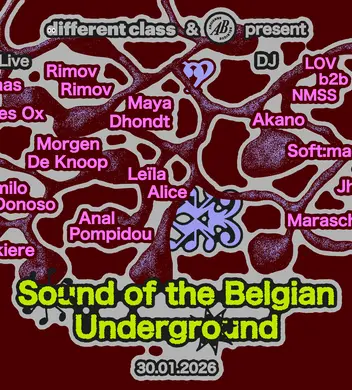


Ahead of her performance at Sound of the Belgian Underground on 30.01.2026 at Ancienne Belgique, visual artist and musician Fleur De Roeck, known as Sinaas, reflects on how her dual practice unfolds day by day. Working from the same large studio, she enjoys that the music resonates throughout the space and influences everything else she creates. From this shared energy to the structures that support her work, she speaks candidly about growing her career on her own terms. We presented her insights on the business side of her practice, drawing on her own experience, to Antonio Cornelis, a business consultant in the artistic and creative sector.
Let’s start with the least appealing part of the business side of your practice. How much time do you spend on planning, administration, or communication?
Quite a lot, more than I’d like. Mondays are usually my admin days, but every morning I spend some time behind my laptop answering emails, planning, managing administration, and following up on communication.
Every morning I spend some time behind my laptop
<img class="editorial-image-50-left" src="https://cdn.prod.website-files.com/61eebcc683107b99137f4423/6938406b894910af63145c2f_000002680014%20.avif"/>
<img class="editorial-image-50-right" src="https://cdn.prod.website-files.com/61eebcc683107b99137f4423/6938406c9062faddbfab1da9_000002680018%20.avif"/>
Which legal structure do you mainly use, and who do you consult for advice?
I mainly work through a social bureau, Amplo, for both my music and artwork, and sometimes I get paid via AKV (amateur arts compensation). When I have questions, I reach out to older artist friends, Amplo, ACV, and Kunstenpunt.
Antonio: While AKV doesn’t provide a significant or secure income, it offers a small bonus in the early stages of a career, meaning around 80 euros per day, up to 30 days per year. The biggest advantage is that you don’t need an artist certificate, which other commissions often require. It’s limited income-wise, but it’s a helpful start. (More info)
When you grow more professional, there are several other ways to secure income as a musician:
Social bureau for artists (SBK in Dutch): Compare the net salaries you receive on your bank account between the different bureaus, as fees differ! Amplo is well-known, but others like Interimpro or De Crew may be cheaper. (Full list of SBK)
1bis or project contracts: 1bis contracts remove the traditional employer-employee hierarchy, while you still maintain worker rights (pension, insurance), but lose certain benefits, like an end-of-year bonus. Project contracts are temporary and last only for the duration of the agreed artistic project.
Employment through a non-profit: You can set up a small organisation with friends or relatives. Once your income reaches a certain level, this can be more advantageous. For example, via my company, RoAn Art Consulting, a gross salary might be around 8,000 euros/year, excluding administrative costs like payroll statements and Dimona registrations. For this, your non-profit will need to work with a payroll office ('sociaal secretariaat' in Dutch).
Independent art worker: This gives full control over your creative pace, career, and income, but it also comes with financial risks. Combining the art worker certificate with independent work on the side has income limits; exceeding them can affect eligibility for benefits after three years. (More info)
<img class="editorial-image-50-left" src="https://cdn.prod.website-files.com/61eebcc683107b99137f4423/6938406cc4897241ac69c579_000002680034.avif"/>
<img class="editorial-image-50-right" src="https://cdn.prod.website-files.com/61eebcc683107b99137f4423/6938406b491db170ac89328f_000002680022%20.avif"/>
Do you have strategies to stabilise income despite fluctuating projects? Do you have other income sources?
I rely on the art worker allowance, which is a real privilege. It allows me to continue creating art and music without needing to accept every commission. I obtained it after a year with multiple exhibitions and sales, which made me eligible for the allowance between projects. It gave me peace of mind and marked an important milestone in my career, while also reinforcing the responsibility of being a professional artist. Eventually, I aim to become fully self-employed, but for now, the allowance is crucial.
Antonio: From 2024 onwards, Belgian artists can apply for an art worker certificate and allowance in two ways:
Starter certificate: For bachelor’s or master’s arts graduates. Requires a five-year business plan, a three-year financial plan, and proof of five artistic assignments worth at least 500 euros gross. No strict deadline; you can apply immediately after graduation or later.
Art worker certificate plus: No degree required, but you must prove prior work as an artist and a minimum gross income of 5,418 euros, including copyright or freelance work. A commission evaluates your portfolio to confirm professional status.
With either certificate, you can apply for a monthly allowance if you can prove 156 days of work over the last 24 months. The amount varies depending on your situation, e.g., living alone or with children. Extensions are possible after three years with proof of 78 days of work.
<img class="editorial-image-50-left" src="https://cdn.prod.website-files.com/61eebcc683107b99137f4423/6938406becdc5749e17b6832_000002680010%20.avif"/>
<img class="editorial-image-50-right" src="https://cdn.prod.website-files.com/61eebcc683107b99137f4423/6938406b5d60c92cff8a8c06_000002680016%20.avif"/>
How important is your personal brand as an artist/musician, and how do you develop it?
A clear visual identity is essential. Years of painting and drawing have shaped my aesthetic, and I carry this into my music and performances. I love bold colours, lines, and dots, and aim to radiate optimism and joy. Dressing in vibrant clothes is part of that; red is a favourite. For Sinaas, it began with a pink hat with dangling dots during concerts, which has since become a signature element. Over time, it has evolved through different projects, like the paper captain’s hat for the Sinaas Summer Show. Chinese ink line drawings are central to my practice, appearing on stickers, t-shirts, and other items. Motifs such as flowers, dots, moons, stars, mountains, and hats recur across paintings, drawings, and lyrics.
I aim to become fully self-employed, but for now, the allowance is crucial
<img class="editorial-image-50-left" src="https://cdn.prod.website-files.com/61eebcc683107b99137f4423/6938406ce06e6bc6e1dd4312_000002680036%20.avif"/>
<img class="editorial-image-50-right" src="https://cdn.prod.website-files.com/61eebcc683107b99137f4423/6938406cec3bb39fa321b8d7_000002680005%20.avif"/>
What role do galleries, labels, or managers play in your professional development?
Galleries provide visibility and access to collectors. They push me to work efficiently and present new work, which encourages reflection and growth. While they aren’t always administratively supportive, they teach you to find your own path. I don’t have a label or manager yet, but that would be welcome.
Do you actively build a network, or does it grow organically?
Mostly organically. I attend exhibitions that interest me and talk to curators if opportunities arise. Occasionally, I reach out proactively, especially for music projects, such as during my residency in Paris. Attending concerts, exhibitions, and performances is a great way to meet people.
<img class="editorial-image-50-left" src="https://cdn.prod.website-files.com/61eebcc683107b99137f4423/6938406b2f6a607138740c30_000002680024.avif"/>
<img class="editorial-image-50-right" src="https://cdn.prod.website-files.com/61eebcc683107b99137f4423/6938406b19ed207093ca7633_000002680002%20.avif"/>
What are the biggest professional challenges in music vs. visual art?
Music demands frequent performances to make a living, with preparation, rehearsals, composing, and recording all taking time. Visual art can bring higher sales per work, but commissions or gallery fees reduce the earnings.
I would have started selling through a social bureau for artists from the beginning rather than using AKV for years
Any lessons learned so far?
I would have started selling through a social bureau for artists from the beginning rather than using AKV for years. It would have built administrative experience sooner and allowed me to save for the art worker certificate and allowance. Also, join a union; they are an invaluable guide along the way.
<img class="editorial-image" src="https://cdn.prod.website-files.com/61eebcc683107b99137f4423/6938406c83ded477629570d4_000002680032.avif"/>
<div class="editorial-banner"> <div class=“editorial-credits”>@fleurderoeck<br><br>personal business advice in the artistic/creative sector:<br>roanartconsult.be</div></div>

Different Class works with the interest of their community at heart.
Our work’s purpose is to foster a solid network for independent artists, those who love them, and those who want to support them. Become a member to contribute to the local Belgian art scene.
Read next
Our membership


